- CasinoNewest
- Blog
- Casino games
Crown and Anchor odds: the three-dice maths behind the 7.9% house edge
Crown and Anchor looks generous, since three dice give you three chances to hit your symbol. The maths of all 216 outcomes shows a 7.9% house edge. Here is the table, a C$5 example and how Canadian law treats the game.
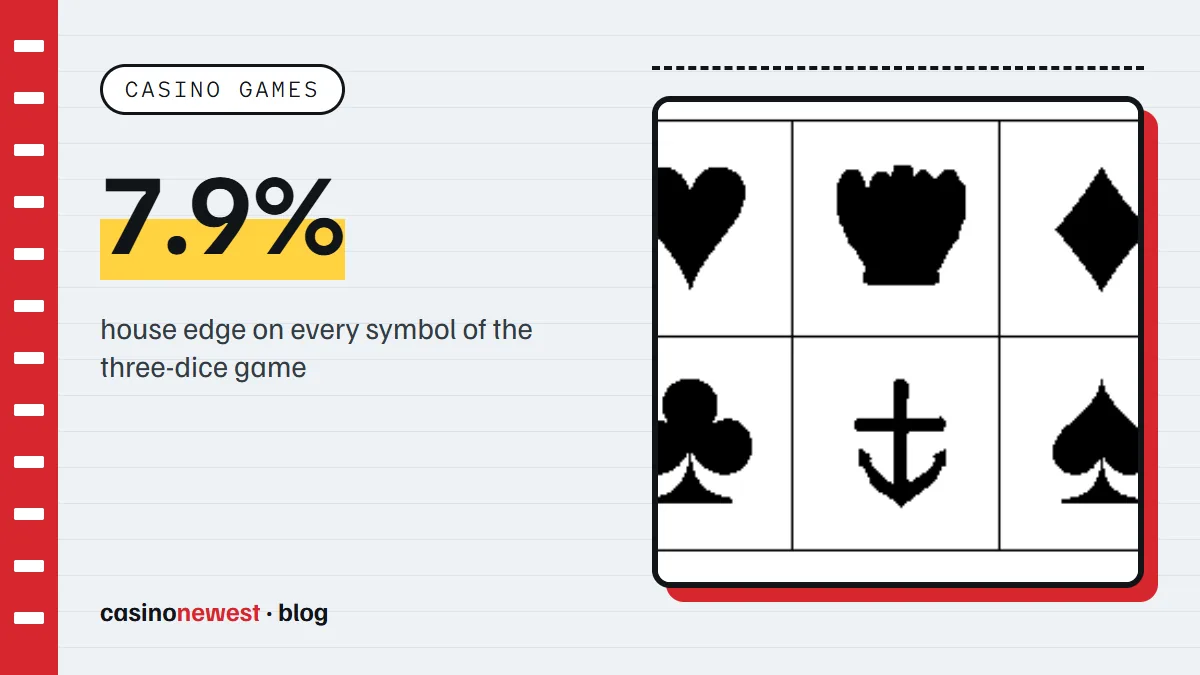
Crown and Anchor is a dice game played on a cloth or board with six symbols: crown, anchor, diamond, spade, club and heart. You put money on one or more symbols, three dice marked with the same six symbols are rolled, and each die that shows your symbol pays you. It feels fair, because each of the three dice has a one in six chance of hitting your symbol. The catch is in how the payouts are set, and it costs you about 7.9 cents on every dollar you wager.
How the game is played
The dice carry the same six symbols as the board. The banker, which is the house at a licensed event, takes bets and rolls. Each die that shows your symbol pays the stake: one match pays even money, two matches pay 2 to 1 and three matches pay 3 to 1, and your original stake is returned along with any winnings. If your symbol does not appear on any die, you lose the bet.
The board is what makes the game feel flexible: you can spread chips across several symbols at once, which looks like a way to cover more of the table. As we will see, covering more symbols does not change the long-run edge.
Counting all 216 outcomes
Three dice with six faces each give 6 x 6 x 6 = 216 equally likely results. Pick one symbol, say the crown. For each die, five of the six faces are "not crown". So:
- No crown on any die: 5 x 5 x 5 = 125 ways.
- Exactly one crown: 3 choices of which die shows it, times 1 x 5 x 5 = 25, so 75 ways.
- Exactly two crowns: 3 choices of which die is the odd one out, times 1 x 1 x 5 = 5, so 15 ways.
- Three crowns: 1 way.
Check: 125 + 75 + 15 + 1 = 216. Now attach the payouts. For a C$5 bet on the crown, the net result for you is:
| Crowns showing | Ways (of 216) | Probability | Your net result on C$5 | Contribution to expectation |
|---|---|---|---|---|
| 0 | 125 | 57.87% | lose C$5 | -C$2.894 |
| 1 | 75 | 34.72% | win C$5 | +C$1.736 |
| 2 | 15 | 6.94% | win C$10 | +C$0.694 |
| 3 | 1 | 0.46% | win C$15 | +C$0.069 |
Add the last column and you get about -C$0.39 per C$5 bet. In fractions, the expected result on a C$1 bet is (-125 + 75 + 30 + 3) / 216 = -17/216, or -7.87%. That is an expected return of about 92 cents per dollar. Over 100 bets of C$5, the average loss is about C$39.35, although the real result will wobble well above and below that.
What an evening looks like: the swings around the edge
An average is not an experience. Each C$1 of stake on one symbol has outcomes of -1, +1, +2 and +3 with the probabilities above, which works out to a standard deviation of about 1.11 units per bet. At C$5 a roll that is roughly C$5.57 per roll, and over 40 rolls about C$35. Your expected result is a loss of about C$16, so a typical range for one evening runs from a profit near C$19 to a loss near C$51. Plenty of people go home ahead, which is exactly why the game survives. The edge only shows up reliably over hundreds of bets.
Why more symbols do not help
A common instinct is to cover three symbols and "win more often". It does win more often, but expected value adds up bet by bet, so each C$1 chip carries the same 7.87% disadvantage. You can prove it with the extreme case: C$1 on each of all six symbols, a C$6 outlay. Across the 216 outcomes there are three patterns:
| Dice pattern | Ways | Net on the C$6 spread |
|---|---|---|
| All three dice different | 120 | C$0 (three symbols win C$1 each, three lose C$1 each) |
| A pair plus one other | 90 | -C$1 |
| Three of a kind | 6 | -C$2 |
The expected result is (0 x 120 - 1 x 90 - 2 x 6) / 216 = -102/216, about -C$0.47 on a C$6 stake, which is again 7.87%. Spreading changes the shape of the ride, not the cost. You never lose more than C$2 and never win a penny, but the house takes the same slice.
A cost near 8% of every dollar staked is steep next to most table games at a licensed casino. For comparison, see how the edge works in our roulette guide, and browse the table games hub for more.
A bit of history: from navy decks to Canadian halls
The game is older than any Canadian licensing scheme. In an oral history held by Veterans Affairs Canada, a First World War veteran, Robert Burton, described the voyage home on a ship carrying about 3,000 troops, where a huge game of Crown and Anchor ran and many aboard took part. He called it a favourite game and arrived home with all of his money. That is not a bad summary of the odds.
Where it fits in Canadian law
Under the Criminal Code, a game of chance with a bank is trouble unless a province has authorized it. The definition of a common gaming house in section 197 covers a place where a bank is kept by one or more but not all of the players, or where part of the bets or proceeds is paid to the keeper. Section 201 makes keeping one an offence. Section 206(1)(g) separately targets inducing a person to stake money on the result of any dice game or on the operation of a wheel of fortune.
The way out is section 207, which makes it lawful for a charitable or religious organization to run a lottery scheme under a provincial licence when the proceeds go to a charitable or religious purpose, and for the board of a designated fair or exhibition to do the same with a licence. Section 206(3) exempts fair boards from parts of section 206, but it expressly excludes dice games, three-card monte, punch boards and coin tables from that exemption, so a licence is what matters. Our overview of Canadian gambling laws walks through how those sections fit together.
Ontario shows how one province handles it in practice. The AGCO's special occasion gaming licence covers a lottery event that is a secondary part of a social occasion, such as a dinner or dance. The Registrar's approved wheels of fortune include a Crown and Anchor wheel alongside Over and Under 7, Chuck-a-Luck, Money and several others. A licensee may run up to 20 wheels at an event, and operating hours must fall within the occasion and not exceed eight consecutive hours between noon and 2 a.m. Note that the approved version there is a wheel, not three loose dice, and the wheel must complete at least three full revolutions before prizes are paid. Rules and approved games differ in other provinces, so an event that is fine in one may not be allowed in another.
Skill, luck and the temptation of systems
There is no skill in Crown and Anchor beyond choosing how much to stake. The dice have no memory, so a symbol that has not appeared for ten rolls is exactly as likely as any other on the eleventh. Betting patterns, such as staking more after a loss, change how fast your money moves but cannot change the 17/216 gap between what the table pays and what the dice produce. The game is best treated as a charity-night novelty with a known price, and that price is the 7.87% above.
What to do before you put a chip down
- Ask who holds the licence. A legal game belongs to a charity or fair, which should be named on the table or the ticket.
- Expect to lose about 8 cents of every dollar you stake, whatever symbols you cover. Decide what that entertainment is worth to you.
- Keep stakes in round numbers and stop at your limit. At C$5 a roll, a quick evening of 40 bets is C$200 in action with an expected cost of about C$16.
- Do not chase. Because spreading does not change the edge, doubling up after a loss only raises the amount at risk.
- Check the age rule for the event: 19 in most provinces, 18 in Alberta, Manitoba and Quebec.
- If the game stops being fun, our responsible gambling page lists tools and helplines.
Questions readers ask
What is the house edge in Crown and Anchor?
About 7.87%. For a C$1 bet on one symbol, the three-dice outcomes give an expected result of -17/216, so you get back about 92 cents on average. The edge is the same whether you bet on one symbol or spread chips across several.
What do the payouts look like?
Each die showing your symbol pays your stake: one match pays even money, two pay 2 to 1 and three pay 3 to 1. You also keep your stake when you win. If no die shows your symbol, the bet loses.
Is Crown and Anchor legal in Canada?
Only when authorized. Section 207 of the Criminal Code allows charities and designated fairs to run lottery schemes under a provincial licence. Ontario's AGCO, for instance, approves a Crown and Anchor wheel for special occasion gaming licences. Unlicensed banked dice games can fall under the common gaming house provisions.
Does betting on all six symbols guarantee a win?
No. With C$1 on each symbol you break even when all three dice differ, lose C$1 when two dice match and lose C$2 when all three match. That averages out to about -7.87% of your C$6 stake, the same edge as a single bet.
How many possible outcomes are there?
There are 216, since three six-sided dice give 6 x 6 x 6 combinations. For one chosen symbol, 125 outcomes show no match, 75 show one, 15 show two and 1 shows three. Those counts produce the probabilities used to calculate the house edge.
Sources
- Wikipedia, Crown and Anchor (rules, payouts and expected return)
- AGCO Lottery Licensing Policy Manual, 6.1.0 Special Occasion Gaming Licence (approved wheels of fortune)
- Criminal Code of Canada, s. 197 (definitions), s. 201 (gaming houses)
- Criminal Code of Canada, s. 206 (lotteries and games of chance offences)
- Criminal Code of Canada, s. 207 (lotteries and provincial licensing)
- Veterans Affairs Canada, Gambling at Sea (Robert Burton oral history)