- CasinoNewest
- Blog
- Lottery culture
Can a lottery winner stay anonymous in Canada? What each provincial lottery requires
Short answer: usually not. Provincial lottery corporations make publicity a condition of paying large prizes, and exceptions are rare and need proof. This guide covers what each province asks for, how group wins work, what the CRA taxes and how long you have to claim.
In Canada, a big lottery win usually comes with a camera. Provincial lottery corporations treat publicity as part of the deal: you get the prize, they publish your name, your town and a photo of you with the cheque. A few jurisdictions in the United States let jackpot winners hide behind a trust or a statutory opt-out, but Canada has no equivalent national rule. Each province sets its own policy, and the bar for an exception is high.
That policy exists because lotteries here are run under provincial authority. Section 207 of the Criminal Code of Canada makes a lottery scheme lawful when a province conducts and manages it under its own law, which is why OLG, Loto-Québec, BCLC, the Western Canada Lottery Corporation and Atlantic Lottery each have their own rules of play and claim forms. The same logic applies to anything you can play for money, so if you want the legal background first, start with our guide to Canadian gambling laws.
Ontario: publicity is the default, exceptions are rare
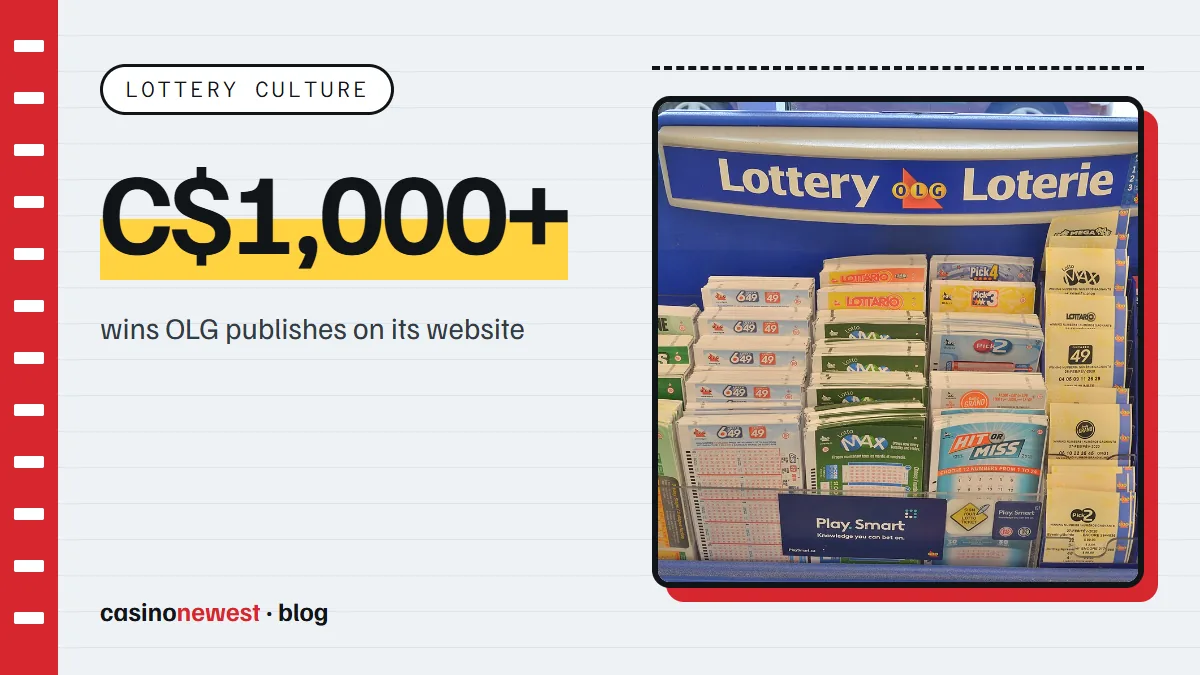
OLG's winners FAQ states that for major prizes it requires a photo of the winner, often with a novelty cheque, taken at the Prize Centre or supplied by the winner when claiming virtually. It also says OLG publishes wins of C$1,000 or more on its website for 30 days and may send a news release and photo of major winners to local media.
The prize claim declaration form is more specific. For prizes of C$1,000 or more, OLG's practice is to publish the winner's legal name, town or city, prize amount and game for 30 calendar days from the date of payment. For prizes of C$10,000 or more, the form says OLG will publish the winner's name, town or city, prize amount, game and a current photograph in the medium of its choice. Signing the form means agreeing to that publication.
One recent change is worth knowing. In May 2026, CTV News reported that OLG would no longer include winners' last names in its news releases. That is a softening of how a win is announced, not an opt-out. The claim form and the FAQ still describe publication on OLG's website for the 30-day period.
Anonymity is available in principle but is not advertised. CTV News has reported that OLG has provisions for anonymity that are rarely granted, with the examples cited being a battered spouse, undercover law enforcement or a risk of harm to the winner, and that a lawyer must make the request. A Markham winner of C$13 million is reported to have persuaded OLG to suppress publicity, with OLG describing the circumstances only as rare. Do not plan around that outcome.
British Columbia: written consent, case-by-case relief
BCLC's published position is that it requires written consent from a winner to publish their personal information, and that a prize may be withheld under its rules if a claimant refuses. BCLC says it considers anonymity requests case by case but that exceptions are rare, and in the best-known case, a C$30 million Lotto 6/49 jackpot from April 2018, it said the circumstances had to be extraordinary and backed by evidence that is verifiable and capable of independent confirmation. BCLC publishes winner information for up to two years, and from January 1, 2026 it stopped printing full last names in media releases. For larger prizes, BCLC says claimants may need to visit a Kamloops or Vancouver office, where staff verify the win, take the photo and interview the winner.
An older British Columbia case shows why workarounds fail. A winner of a C$50 million prize argued that the ticket had been transferred to a trust that should be allowed to claim it. The lottery corporation rejected that, holding that only an individual or group of individuals could claim a prize. After 21 months, the ticket was transferred back to the winner, who claimed with full publicity, according to a Hull and Hull legal commentary.
Quebec, Alberta and the Atlantic provinces
Atlantic Lottery's winners publicity policy says it reserves the right to publicize a winner's name, hometown, amount won and photograph for up to one year from the date the prize was claimed. Its claim page says winners of C$25,000 or more must allow use of their full name, city, province, prize amount, game and a current photograph.
Loto-Québec's published claim pages describe how to claim, not how winners are publicized. They say the prize is paid to the legitimate holder of the ticket, taking into account the name written on it, and that you may be asked to prove legal capacity to receive a prize. We did not find a published Loto-Québec statement on winner photos or anonymity, so if privacy matters to you, ask before you sign anything. The same goes for Alberta: AGLC's lottery page explains that prize payout offices work by appointment, with prizes from C$1,001 to C$9,999.99 claimable in Calgary and St. Albert and prizes of C$10,000 or more claimable only in St. Albert, but the pages we reviewed do not state a publicity policy.
| Lottery corporation | Claim deadline | What is published | Anonymity |
|---|---|---|---|
| OLG (Ontario) | One year from the draw date for terminal tickets; the printed expiry date for INSTANT tickets | Name and town for 30 days from C$1,000; photo from C$10,000 | Provisions exist but are rarely granted |
| BCLC (British Columbia) | 52 weeks from the draw date, according to BCLC materials | Name, photo and story with written consent; up to two years | Case by case; rare |
| Atlantic Lottery | One year from the draw date, or the date on the ticket if earlier | Name, hometown, photo for up to one year from the claim date | Not stated on the pages reviewed |
| Loto-Québec | One year from the draw date | Not stated on the claim pages reviewed | Not stated |
| AGLC and WCLC (Alberta) | Not confirmed here | Not stated on the AGLC page reviewed | Not stated |
Read the table as a floor, not a promise. Rules get revised, so check the claim form for your own ticket before signing.
Group wins and office pools
Many large jackpots are won by a group. OLG defines a group claim as one made by two or more people who played together and won, with each member's share declared. For online claims the Group Leader submits the form, and OLG collects information from the other members. A Lottery Prize Claim Group List signed in ink by all members is required. In practice that means every member of an office pool is identified to the lottery corporation, even if only the leader fronts the media.
The best protection is a written pool agreement made before the draw. It should name every member, say who holds the tickets, state each share, and say what happens if someone leaves. Fix the claim steps too: who submits the form, who attends any photo appointment, and who speaks to reporters. Disputes over pools tend to come from vague promises, not from the lottery rules.
Tax: the prize is free, the interest is not
The Canada Revenue Agency does not tax lottery winnings. Its folio on lottery winnings states that a prize from a lottery scheme is not taxable as either a capital gain or income, unless the circumstances make it employment, business or property income, or an achievement prize. For a syndicate, the folio says the income tax consequences to each member are the same.
Here is a worked example. Ten co-workers share a C$1,000,000 jackpot equally, so each member receives C$100,000 with no tax withheld and nothing to report as income. If one member puts that C$100,000 in a savings account paying 3 per cent, the C$3,000 of interest in the first year is taxable on that person's return, because CRA says interest earned from investing lottery winnings must be reported. If the prize is paid as an annuity, the folio notes that the income portion of each payment is determined under the Income Tax Act's annuity rules and that the issuer should provide the calculation.
How long do you have to claim, and how fast do you get paid?
Deadlines are strict. OLG says customers have exactly one year from the draw date to claim a ticket printed from a lottery terminal, and the printed expiry date for INSTANT games. Atlantic Lottery's rules say one year from the draw, or the time limit on the ticket if earlier. Loto-Québec's pages give 365 days from the draw date. Speed is different from deadline: OLG says online claims are typically processed within 5 business days of a complete submission, while mailed claims take 6 to 8 weeks. Larger prizes usually involve an in-person appointment and identity checks that add time.
A practical checklist if you ever win
- Sign the back of the ticket and photograph both sides before you do anything else.
- Put the ticket in a safe place and tell as few people as possible.
- Read the claim form's publicity clause line by line before signing.
- If you have a real safety concern, contact the lottery corporation in writing, with a lawyer, before you claim. Do not rely on a trust or numbered company to hide your name.
- For a pool, gather every member's information and the signed agreement before the appointment.
- Speak to a tax adviser before investing, since the prize is tax-free but the income it generates is not.
- If a winning ticket makes you want to play more, our page on responsible gambling has tools and help lines.
Questions readers ask
Can I claim a lottery prize through a trust or company to stay anonymous?
Do not count on it. In a reported British Columbia case, a winner argued a trust should claim a C$50 million prize, and the lottery corporation held that only an individual or group of individuals could claim. The winner ultimately claimed in his own name with publicity. Check the claim form's eligibility rules before transferring any ticket.
Does OLG still publish my last name?
CTV News reported in May 2026 that OLG would stop including winners' last names in news releases. The prize claim declaration form still says OLG publishes the legal name, town and prize details of wins of C$1,000 or more on its website for 30 calendar days, so confirm the current wording on your form.
Is a lottery jackpot taxable in Canada?
The prize itself is not. The CRA folio on lottery winnings says a lottery prize is not taxable as income or a capital gain, unless it is employment, business or property income or an achievement prize. Interest or other income you earn by investing the money is taxable and must be reported on your return.
How do office pool winners claim together?
At OLG, a Group Leader submits the claim form online, each member's share is declared, and a Lottery Prize Claim Group List signed in ink by all members is required. Having a written pool agreement before the draw makes this far easier, because it records who is in the pool and how the prize is split.
How long do I have to claim a Canadian lottery prize?
OLG gives exactly one year from the draw date for terminal tickets, and the printed expiry date for INSTANT games. Atlantic Lottery's rules say one year from the draw or the date on the ticket, whichever is earlier. BCLC materials refer to 52 weeks. Always read your own ticket and the current rules.
Sources
- OLG: Winners FAQ
- OLG: Lottery Prize Claim Declaration Form for prizes of C$1,000 or more
- CTV News: Last name of lottery winners will no longer be included in OLG news releases
- CTV News: Can you claim a winning lottery ticket in Ontario anonymously?
- BCLC: Publicizing Lottery Winners
- Atlantic Lottery: Winners publicity policy
- Loto-Québec: Claiming a prize
- AGLC: Lotteries
- Hull and Hull: Can you win the lottery and remain anonymous?
- CRA: Income Tax Folio S3-F9-C1, Lottery Winnings
- CRA: Amounts that are not reported or taxed
- Justice Laws: Criminal Code, section 207