- CasinoNewest
- Blog
- Hockey betting
NHL 50/50 draws in Canada: how they work, how to size up your odds and where the other half goes
A 50/50 draw looks like a simple raffle, but it runs on a charity licence, a geolocation check and a prize that grows with every sale. Here is how Oilers, Maple Leafs and Canadiens draws work, what your odds look like in C$, and how the prize is taxed.
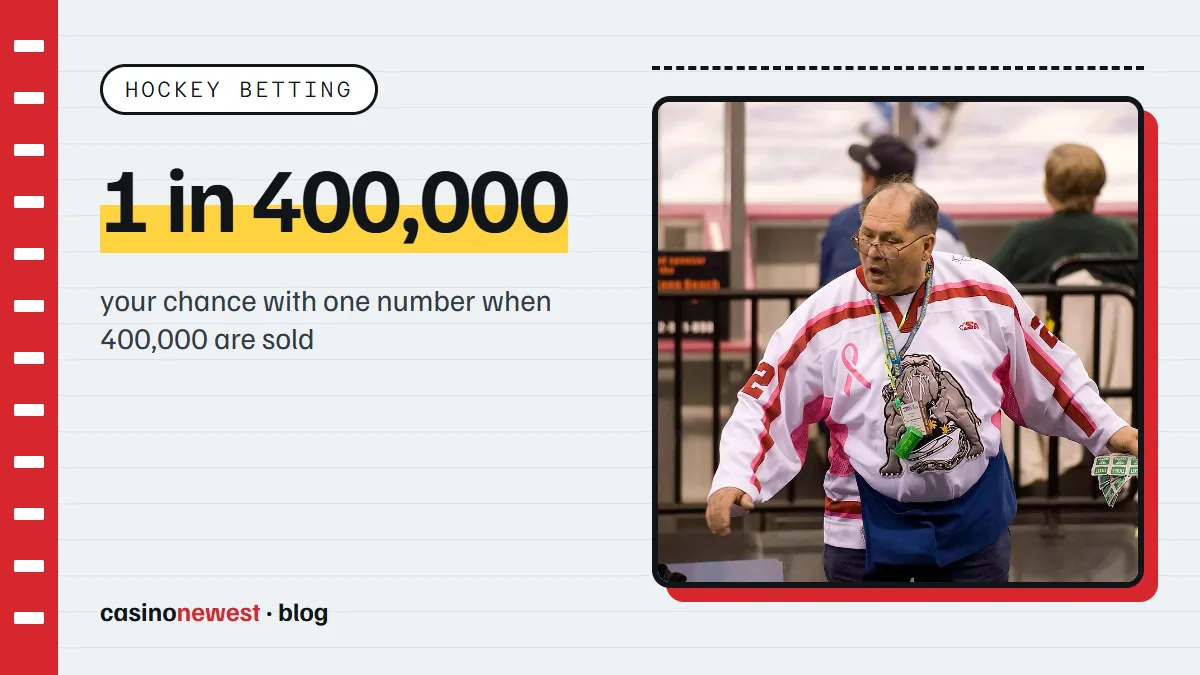
A 50/50 draw is a raffle where the winner takes a share of the ticket money and a registered charity keeps the rest. At NHL and CFL games across Canada the jackpot is not fixed in advance: it is a percentage of whatever fans buy before the draw closes. That one design choice explains almost everything else, from why the prize can swing from a few thousand dollars to millions, to why your odds depend on how many other people are buying.
This is not sports betting and it is not a casino product. It is a charitable lottery scheme, and in Canada those sit under their own corner of the law. If you came here from our hockey betting pages, think of the 50/50 as a different animal that happens to share the arena.
Why a 50/50 is legal: the charity licence behind it
Section 207 of the Criminal Code of Canada makes lottery schemes lawful when a province runs them, and also when a charitable or religious organization runs one under a licence from the province, provided the proceeds go to a charitable or religious purpose. A team foundation is exactly that kind of organization. The licence can carry conditions covering how the scheme is conducted, managed and operated, and who may take part. Those conditions are where the geography rules come from. For the wider legal picture, see our guide to Canadian gambling laws.
In Alberta the regulator is the Alberta Gaming, Liquor and Cannabis Commission, AGLC. Its raffle terms say a licensed charity must run the raffle completely within Alberta and must have a way to check that each ticket buyer is old enough and located in Alberta at the time of purchase. The same terms say a percentage draw such as a 50/50 must pay a prize between 20 and 80 per cent of gross ticket sales. Fifty per cent is the convention, not a legal requirement.
Why online sales stop at the provincial border
Online 50/50 sales arrived for large Alberta draws in July 2020, when AGLC announced that charities could sell tickets online to adult Albertans and lowered the total ticket value at which a random number generator can pick the winner from C$1 million to C$100,000. The word that matters is Alberta. A licence issued by one province does not travel, so a platform has to prove where you are standing when you tap Pay. That is what geolocation does: it reads your device or network location and blocks the sale if you are outside the licensed province.
The same logic applies elsewhere. The Edmonton Oilers Community Foundation, which holds the AGLC licence for the Oilers draw, states on its 50/50 page that tickets are sold only in Alberta and that buyers must be within the province's borders at purchase. The Canadiens Foundation says you can buy online anywhere in Quebec, but you must be 18 or older and physically in Quebec. The MLSE Foundation launched its online draw for Maple Leafs and Raptors home games as its first online partnership with the Alcohol and Gaming Commission of Ontario, open to fans anywhere in Ontario. Note the pattern: it is where you are, not where you live. A visitor can usually play, and a resident on holiday cannot.
| Team draw | Province | Licence or regulator named by the source | Where the buyer must be |
|---|---|---|---|
| Edmonton Oilers | Alberta | AGLC licences held by the Edmonton Oilers Community Foundation | Inside Alberta at purchase, age 18 or older |
| Toronto Maple Leafs | Ontario | AGCO lottery licences listed by the MLSE Foundation | Anywhere in Ontario for the online draw |
| Montreal Canadiens | Quebec | Draw run by the Canadiens Foundation | Physically in Quebec, 18 or older |
Rules change from season to season and from raffle to raffle, so always read the rules of play on the draw's own page before you pay.
Working out your odds in C$
Every number in a 50/50 has the same chance. If 400,000 numbers are sold in total and you hold one, your chance is 1 in 400,000. The catch is that packages change how many numbers you get per dollar. The Oilers rules page lists, for one raffle, C$10 for 10 numbers, C$29 for 97, C$50 for 250 and C$100 for 550, with separate bonus raffles on top. Prices have differed between raffles and years, which is why you check the rules first.
Here is a worked example. Assume 400,000 numbers are sold in total, including yours, and that the draw raised C$200,000, so the jackpot is C$100,000.
| What you buy | Numbers held | Chance to win | Average return on the C$100,000 jackpot |
|---|---|---|---|
| One C$10 pack | 10 | 0.0025% (1 in 40,000) | C$2.50 |
| Ten C$10 packs (C$100) | 100 | 0.025% (1 in 4,000) | C$25.00 |
| One C$100 pack | 550 | 0.1375% (about 1 in 727) | C$137.50 |
Two lessons sit in that table. First, spending the same C$100 in two different ways gives you 100 numbers or 550, which is more than five times the chance. Second, the C$137.50 is flattering, and you should understand why. In the example, other buyers paid more per number than you did, so the jackpot was built from their higher prices. If everyone had bought the C$100 pack, 400,000 numbers would raise only about C$72,727, the jackpot would be about C$36,364, and your 550 numbers would return an average of C$50 on C$100. That is the honest benchmark: when everyone pays the same rate, the average return is half of what you spend, because the other half is not prize money at all.
This is worth saying plainly. A 50/50 is a donation with a lottery ticket attached. The average player gets back about half of what they put in, and most players get nothing. Buying a bigger pack improves your odds per dollar, not your odds of coming out ahead.
Record pots and why they get messy
The largest pots on record came from online sales. During the Oilers' 2020 Stanley Cup qualifying series against Chicago, The Globe and Mail reported that sales reached C$9.4 million over three games, with C$5.4 million on the Wednesday alone, and that the Wednesday winner took home C$2,708,565, which the team called a world record for a sports 50/50. Half of all sales went to the foundation. Tickets in that run cost C$5 each or C$50 for 200. The previous record cited was about C$2 million, from a Toronto Raptors draw in the 2019 NBA Finals, and a typical NHL 50/50 raises up to about C$100,000.
Records also exposed the weak points. Some fans were charged for more tickets than they intended, and the Oilers postponed a draw so overcharged buyers could void their tickets before a winner was picked. If you buy online, check your receipt immediately, and read the refund and claim rules. The Oilers page, for example, says winners have until 4 pm Mountain time four business days after the winning number is posted to claim, that payment is by cheque within 60 days of submitting the ticket and paperwork, and that unclaimed prizes are added to jackpots.
Is the prize taxable?
No. The Canada Revenue Agency's folio on lottery winnings says a prize from a lottery scheme is not taxable as either a capital gain or income, unless the circumstances make it employment, business or property income, or an achievement prize. A C$100,000 or C$2.7 million 50/50 jackpot is not reported as income and has no tax withheld.
The exception is what you do with the money afterwards. CRA's guidance says interest you earn when you invest lottery winnings must be reported on your return. If you put a C$100,000 jackpot into an account paying 3 per cent, the C$3,000 a year of interest is taxable income, even though the C$100,000 itself is not. Ask a tax professional before you build a portfolio around a windfall.
Where the other half goes
The non-winning half goes to the licensed charity named in the draw. For the Oilers, the beneficiary is the Edmonton Oilers Community Foundation, and the rules page says beneficiaries receive a share of net raffle proceeds set raffle by raffle. The MLSE Foundation says half of ticket revenue goes to the winner and half to the benefiting charity. The Canadiens Foundation says its half supports activity programs for youth from underprivileged neighbourhoods. Where a draw allows a different split, it will say so in the rules, and the AGLC 20 to 80 per cent band is the ceiling and floor for the prize in Alberta.
Before you buy a ticket: a short checklist
- Read the rules of play on the team foundation's own draw page, not a social post.
- Confirm your location will pass the check. Turn off a VPN and allow location access.
- Compare the packages. Work out the cost per number, not just the headline price.
- Set a budget before the draw opens, because the jackpot ticker is designed to make late buying feel urgent.
- Keep the emailed receipt and the numbers until the winning number is posted and the claim window has closed.
- If a draw is the only gambling you do, treat it as a charity gift. If you feel pulled to buy more, see our page on responsible gambling.
Questions readers ask
Can I buy an Oilers 50/50 ticket if I live outside Alberta?
Only if you are physically in Alberta when you buy. The Edmonton Oilers Community Foundation states that tickets are sold only in Alberta and buyers must be within the province's borders at purchase. AGLC raffle terms require a charity to verify that the buyer is of age and located in Alberta at the time of purchase.
Is a 50/50 jackpot always exactly half of sales?
Half is the usual split, and the MLSE Foundation and Canadiens Foundation both describe it that way. In Alberta, AGLC raffle terms allow a percentage draw prize between 20 and 80 per cent of gross ticket sales, so the rules of each draw tell you the actual share.
Does a bigger package improve my odds?
It improves your odds per dollar, because bigger packages give more numbers for each dollar. It does not change the economics of the draw. When every buyer pays the same rate per number, the average return is about half of what you spend, because the other half goes to the charity.
Do I pay tax on a 50/50 prize?
No tax is charged on the prize itself. CRA's folio says a prize from a lottery scheme is not taxable as income or as a capital gain, unless it is employment, business or property income or an achievement prize. Interest you later earn by investing the money is taxable and must be reported.
What happens if nobody claims the winning ticket?
That depends on the draw's rules. The Oilers page says unclaimed prizes are added to jackpots, and winners must present the ticket within four business days of the winning number being posted. Other charities publish different deadlines, so check the rules of play before the draw closes.
Sources
- Edmonton Oilers: 50/50 raffle rules and information
- AGLC: Raffle Terms and Conditions
- Global News: Alberta introduces online 50/50 ticket sales
- The Globe and Mail: Edmonton Oilers 50/50 draws shattering records
- MLSE Foundation: 50|50
- MLSE Foundation: Online 50/50 raffle launch
- Canadiens Foundation: 50/50 raffles
- Justice Laws: Criminal Code, section 207
- CRA: Income Tax Folio S3-F9-C1, Lottery Winnings
- CRA: Amounts that are not reported or taxed