- CasinoNewest
- Blog
- Hockey betting
NHL regulation-time betting: how the 60-minute line differs from the moneyline and puck line
The same NHL game can pay three different ways depending on whether you bet the 60-minute line, the moneyline or the puck line. Here is how overtime and shootouts settle each market, and how to turn 3-way odds into probabilities.
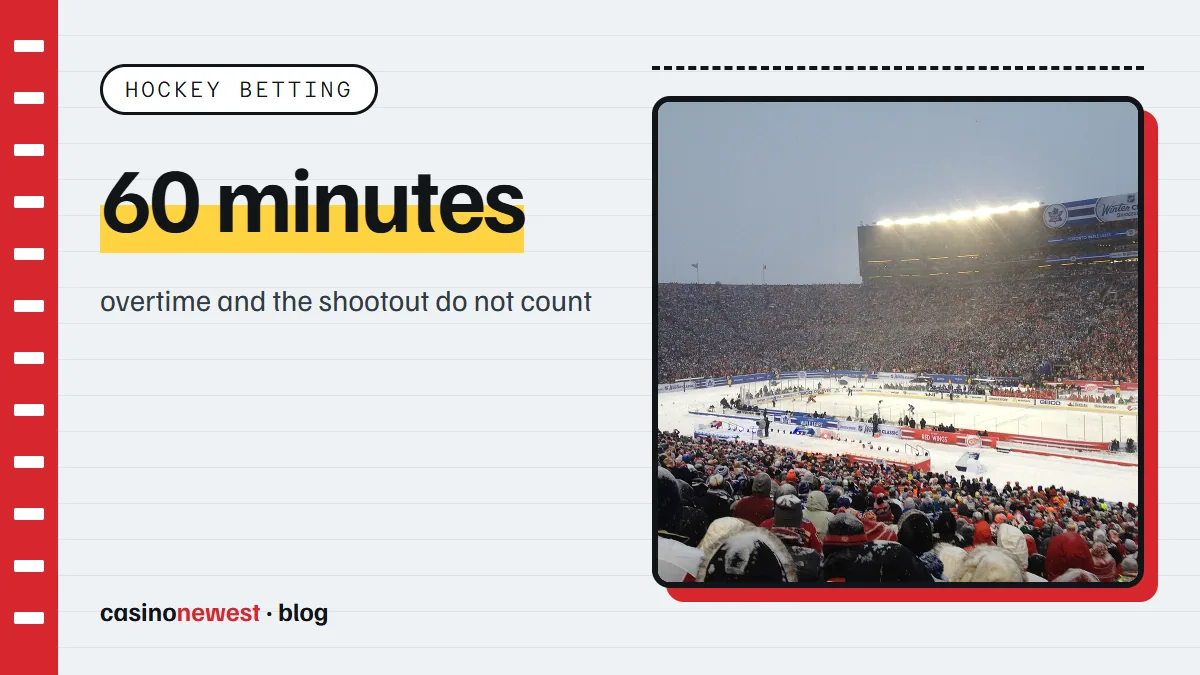
An NHL regular-season game does not always end when the third period does. If it is tied after 60 minutes, it goes to a five-minute overtime and then, if needed, a shootout. Your bet might be settled at the horn, at the first overtime goal, or only after a skills competition, and that single detail explains most of the confusion around the three main hockey markets: the 60-minute line, the moneyline and the puck line.
Below is how each market is settled, how to read 3-way odds as probabilities, and a C$20 bet run through all three on the same game.
How an NHL game actually ends
Regulation is three 20-minute periods. In the regular season, a game tied after 60 minutes goes to a sudden-death overtime of five minutes, played 3-on-3 with a goaltender each. The format has been used since the 2015-16 season. If nobody scores, the game is decided by a shootout: each team sends three shooters one-on-one against the opposing goaltender, and extra rounds follow until someone wins. Shootouts have been part of the NHL since 2005-06.
The standings reward that structure. Each team gets a point for a game that goes past 60 minutes, and the winner gets an extra point. The playoffs are different. There is no shootout; tied games continue with 20-minute sudden-death periods at five-on-five until someone scores. A 60-minute market in the playoffs still pays on what the score is after three periods, even though the game keeps going.
The three markets in one table
| Market | What you bet | Overtime and shootout |
|---|---|---|
| 60-minute line (3-way) | Home win, draw or away win after regulation | If tied after 60 minutes, the draw wins, whoever takes the game later |
| Moneyline (2-way) | Which team wins the game | Overtime and shootout count; the final winner collects |
| Puck line (spread) | Favourite -1.5 goals or underdog +1.5 goals | Overtime and shootout count, but the game ends with a one-goal margin |
The 60-minute line is also called the regulation-time or 3-way market. It removes overtime and the shootout from the picture and adds a third outcome, the tie. That makes it the closest thing in hockey to a soccer bet.
The moneyline is a straight bet on who wins the game, however it ends. In standard practice a team that wins in overtime or the shootout is credited with a one-goal win, so the final score looks like 3-2.
The puck line is hockey's spread. The usual number is 1.5 goals. A favourite at -1.5 must win by two or more, which can only happen in regulation, because sudden-death overtime ends at the first goal. An underdog at +1.5 wins the bet if it wins the game or loses by exactly one, which includes every overtime and shootout loss.
Rules for other markets vary. Whether goals scored in overtime count toward team totals, for example, differs from book to book, so read your operator's hockey rules before you bet anything beyond these three. Our guide to sports bet types covers the full list.
Turning 3-way odds into probabilities
Every decimal price implies a probability: divide 1 by the odds. The three implied probabilities add up to more than 100 percent, and the surplus is the bookmaker's margin, sometimes called the overround. Divide each implied probability by the total and you get a fair estimate with the margin stripped out.
Take a hypothetical 60-minute line with decimal odds of 2.15 for the home team, 4.00 for the draw and 3.00 for the away team.
| Outcome | Decimal odds | Implied probability | Fair probability after removing margin |
|---|---|---|---|
| Home win in regulation | 2.15 | 46.51% | 44.36% |
| Draw after 60 minutes | 4.00 | 25.00% | 23.85% |
| Away win in regulation | 3.00 | 33.33% | 31.79% |
| Total | 104.84% | 100.00% |
The margin on that market is 4.84 percent. Run the same maths on a two-way moneyline of 1.62 on the home team and 2.30 on the away team: the implied probabilities are 61.73 percent and 43.48 percent, summing to 105.21 percent. Stripped of margin, the home team wins the game about 58.7 percent of the time and the away team about 41.3 percent.
Notice what the two markets say together. The 3-way line puts the home team at 44.4 percent to win in regulation. The moneyline puts it at 58.7 percent to win overall. The difference, roughly 14.3 percentage points, is the share of the roughly 23.9 percent chance of a tie that the home side is expected to win in overtime or the shootout, about 60 percent of those ties. Checking that your inputs line up like this is a quick way to see whether a price is out of step. The prices here are illustrative, not quotes from any operator.
One game, three markets, C$20 each
Suppose you stake C$20 on the home team in each market, using hypothetical prices: 2.15 on the 60-minute line, 1.62 on the moneyline and 2.75 on the puck line at -1.5. A winning bet would return C$43.00, C$32.40 and C$55.00, which is a profit of C$23.00, C$12.40 and C$35.00.
| How the game ends | 60-minute line | Moneyline | Puck line -1.5 | Net on C$60 staked |
|---|---|---|---|---|
| Home wins 4-1 in regulation | +C$23.00 | +C$12.40 | +C$35.00 | +C$70.40 |
| Home wins 3-1 in regulation | +C$23.00 | +C$12.40 | +C$35.00 | +C$70.40 |
| Home wins 3-2 in regulation | +C$23.00 | +C$12.40 | -C$20.00 | +C$15.40 |
| Home wins 3-2 in overtime | -C$20.00 | +C$12.40 | -C$20.00 | -C$27.60 |
| Home wins in a shootout | -C$20.00 | +C$12.40 | -C$20.00 | -C$27.60 |
| Away team wins in overtime | -C$20.00 | -C$20.00 | -C$20.00 | -C$60.00 |
The overtime row is the lesson. A home win that comes after 60 minutes loses the 60-minute bet, wins the moneyline and loses the puck line. The same game, three different tickets.
You can also bet the draw. At 4.00, a C$20 stake on a tie after 60 minutes returns C$80.00, a profit of C$60.00, and it wins whenever the game goes to overtime, no matter who wins it. If you expect a tight defensive game between two even teams, that is the only market that pays directly on it.
When the 3-way line is the better bet
The 3-way line is a better fit than the moneyline in a few cases. First, when you rate the favourite to win in regulation more often than the price implies. If you think the home team wins in 60 minutes half the time, the fair price is 2.00, and a 2.15 line has a theoretical edge of 7.5 percent (0.50 x 2.15 = 1.075). The moneyline at 1.62 would need 61.7 percent to break even, a much higher bar because it also covers overtime.
Second, when the favourite is strong but the price is short. A heavy moneyline favourite pays little. The same team on the 60-minute line pays more, because you accept the risk of a tie, which is the same trade the puck line makes by asking for a two-goal win.
Third, when two evenly matched teams meet in a grinding game, backing the draw gives you a price on the most uncertain outcome. The cost is that a draw at 4.00 implies a 25 percent chance, so it offers value only if your own estimate is higher.
The moneyline is better when you only care who wins, and the puck line when you want a bigger price on a dominant team or protection for an underdog. For a wider view of stake sizing and line shopping, see our sports betting strategy page.
A short checklist before you place the bet
- Check the operator's hockey rules for how overtime, the shootout and playoff overtime are treated in each market.
- Convert the odds to probabilities and confirm the margin. A margin much above 6 percent on a major game is worth shopping around.
- Decide which question you are answering: who wins, who wins in 60 minutes or by how much.
- Stake a fixed amount you can afford to lose; overtime swings both ways.
- For team-by-team resources, markets and sportsbooks, start from our hub on betting on ice hockey online.
None of this makes hockey bets safer, it only makes the terms of the bet clearer. If betting stops being fun, our responsible gambling page lists tools and help lines.
Questions readers ask
What does the 60-minute line mean in NHL betting?
It is a 3-way market that settles on the score after the three regulation periods. You can back the home team, the away team or a draw. If the game is tied at 60 minutes, the draw bet wins regardless of who wins in overtime or a shootout.
Does overtime count on a NHL moneyline bet?
Yes. A moneyline bet is on who wins the game, so a win in the five-minute 3-on-3 overtime or in the shootout counts. In the playoffs, where there is no shootout, overtime continues in 20-minute sudden-death periods until someone scores.
How does a puck line bet work with a shootout?
The usual puck line is 1.5 goals. A shootout game ends with a one-goal margin for the winner, so a favourite at -1.5 loses and an underdog at +1.5 wins even though it lost the game. Check the operator's rules to confirm.
How do I convert 3-way odds into probabilities?
Divide 1 by each decimal price, add the three results, and divide each result by that sum. The excess over 100 percent is the margin. With 2.15, 4.00 and 3.00 the total is 104.84 percent, so the fair chances are 44.4, 23.9 and 31.8 percent.
Are NHL playoff games different for 60-minute bets?
The 60-minute line still settles on the score after regulation, but the game itself continues with 20-minute sudden-death overtime periods played five-on-five and no shootout. A tie after three periods therefore pays the draw even though a team must still win later.